
Please Wait
A pupil stands with their back to the board so they can't see the word(s) above. Their challenge is to guess the word from clues given by the class.
New word:

Please Wait
A pupil stands with their back to the board so they can't see the word(s) above. Their challenge is to guess the word from clues given by the class.
New word:
|
Comment recorded on the 1 February 'Starter of the Day' page by Terry Shaw, Beaulieu Convent School: "Really good site. Lots of good ideas for starters. Use it most of the time in KS3." Comment recorded on the 3 October 'Starter of the Day' page by S Mirza, Park High School, Colne: "Very good starters, help pupils settle very well in maths classroom." Comment recorded on the 24 May 'Starter of the Day' page by Ruth Seward, Hagley Park Sports College: "Find the starters wonderful; students enjoy them and often want to use the idea generated by the starter in other parts of the lesson. Keep up the good work" Comment recorded on the 25 June 'Starter of the Day' page by Inger.kisby@herts and essex.herts.sch.uk, : "We all love your starters. It is so good to have such a collection. We use them for all age groups and abilities. Have particularly enjoyed KIM's game, as we have not used that for Mathematics before. Keep up the good work and thank you very much Comment recorded on the 1 May 'Starter of the Day' page by Phil Anthony, Head of Maths, Stourport High School: "What a brilliant website. We have just started to use the 'starter-of-the-day' in our yr9 lessons to try them out before we change from a high school to a secondary school in September. This is one of the best resources on-line we have found. The kids and staff love it. Well done an thank you very much for making my maths lessons more interesting and fun." |
Game 1A pupil stands with his or her back to the screen and the teacher selects a word (Click the button above) Members of the class give clues so that the person with their back to the screen can guess the word Game 2If a large screen isn't available the teacher could select a word and a pupil could come up to the teacher's computer to read it. This pupil then gives clues to the rest of the class to guess the word. Whoever guesses it first is the next to be the clue giver. Game 3Pupils are divided into two teams. One member of each team stands with their backs to the screen and the teacher selects a word (Click the button above). The two teams take turns giving their team member a clue to the mystery word. The first team member to guess the word wins a point for their team. Game 4Play as the party game "Charades". No talking allowed. Game 5A pupil stands with his or her back to the screen and the teacher selects a word (Click the button above) The pupil asks the rest of the class questions which they can only answer "Yes" or "No". The pupil attempts to guess the word with the minimum number of questions. E.g. "Is it a shape?" "Have we seen this word recently?" "Is the word associated with probability?" "Does it have less than five letters?" Game 6Pupils could play the games suggested above in pairs if they have at least one computer, laptop, iPad or similar between them. Word DifficultyThe categories of Easy, Medium and Hard need explaining. The previous version of this application had the facility for teachers to vote on each word that was randomly selected from our database of 559 mathematical words and phrases. The votes indicated how suitable the teachers thought the words were for this game. After collecting over 85000 of these votes we have arbitrarily divided up the database in to three sections accordingly. You will probably find some words are not in the category that you would put them in so we suggest you just skip those words and go on to select another. |
Featured ActivityShunting Puzzles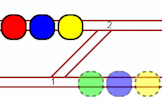 These puzzles are Transum's versions of the shunting or switching puzzles made popular by train enthusiasts and logic puzzle solvers. Recently UpdatedNot Too Close The students numbered 1 to 8 should sit on the chairs so that no two consecutively numbered students sit next to each other. So far this activity has been accessed 53466 times and 647 people have earned a Transum Trophy for completing it. |


Sharee Hebert, X Social Network
Friday, June 14, 2019
"Just ended my term with year 7 with this word guessing game. Students were great at getting me to guess the words! They also loved being able to have their backs to the board to guess.
Sharee (@MrsHebertMath)
[Transum: Thank you very much for your comment Sharee. I am so pleased to hear how well your Year 7 students participated.]"