
|
|
Exam-Style Questions.Problems adapted from questions set for previous Mathematics exams. |
1. | GCSE Higher |
The diagram below is a sketch of \(y = f(x)\) where \(f(x)\) is a quadratic function.
The graph intersects the x-axis where \(x=-2\) and \(x = 0.5\).
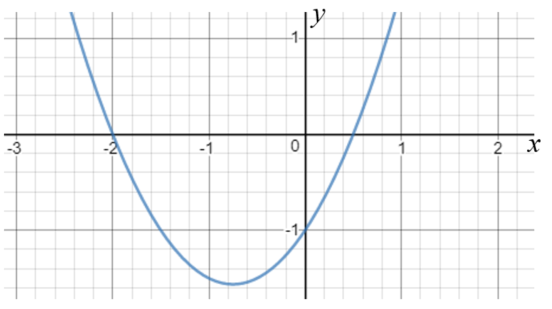
Which of the following is the solution of \(f(x) \le 0\) ?
2. | GCSE Higher |
\(3x^2+9x-12\) can be written in the form \(a(x+b)^2-c\).
Find the values of \(a\), \(b\) and \(c\).
3. | GCSE Higher |
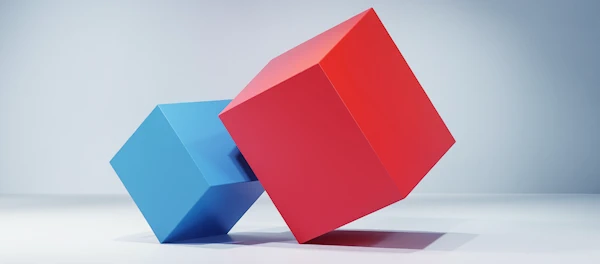
The volume of the larger red cube is 386cm3 greater than the volume of the smaller blue cube.
The lengths of the edges of the blue cube can be expressed as \(x\) cm.
The lengths of the edges of the red cube can be expressed as \(x+2\) cm.
(a) Show that \( x^2 + 2x - 63 = 0 \).
(b) Find the volume of the blue cube.
4. | GCSE Higher |
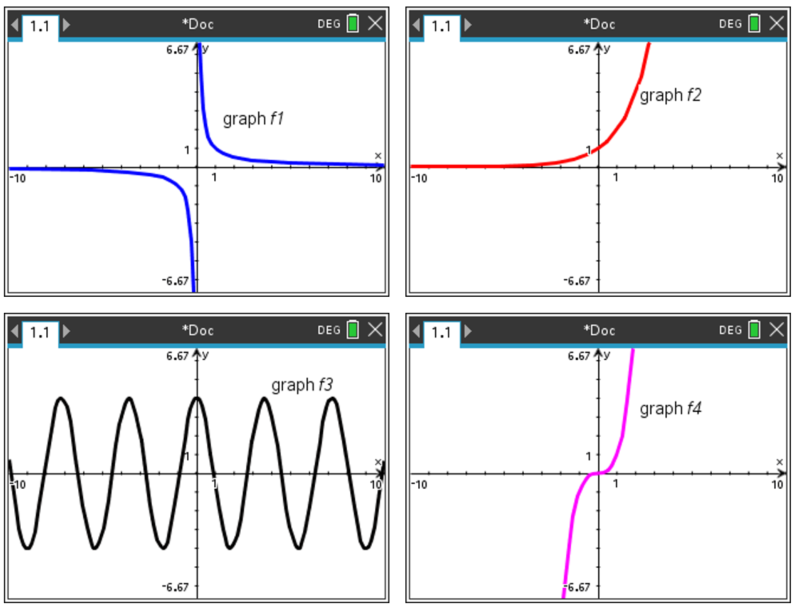
The images below show a graphic display calculator screen with different functions displayed as graphs.
a) Which function is trigonometric?
b) Which function is inversely proportional to \(x\)?
c) Which function is exponential?
d) Which function is proportional to \(x^3\)?
5. | GCSE Higher |
(a) Write \(x^2 - 6x + 5\) in the form \((x-a)^2 + b\).
(b) Write down the coordinates of the turning point of the graph of \(y = x^2 - 6x + 5\).
6. | GCSE Higher |
Match the equation with the letter of its graph
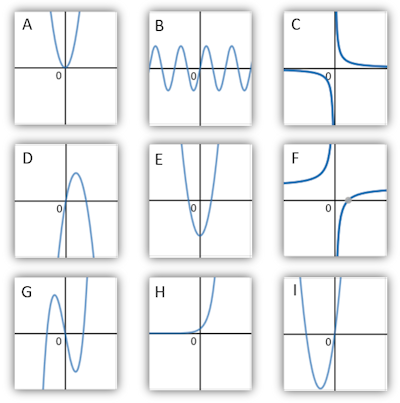
| Equation | Graph |
|---|---|
| $$y=3-\frac{10}{x}$$ | |
| $$y=2^x$$ | |
| $$y=\sin x$$ | |
| $$y=x^2+7x$$ | |
| $$y=x^2-8$$ | |
| $$y= \dfrac{5}{x} $$ |
7. | GCSE Higher |
The graph of the curve A with equation \(y=f(x)\) is transformed to give the graph of the curve B with equation \(y=5-f(x)\).
The point on A with coordinates (3, 9) is mapped to the point W on B.
Find the coordinates of W.
8. | GCSE Higher |
The graph of y = f(x) is drawn accurately on the grid.
(a) Write down the coordinates of the turning point of the graph.
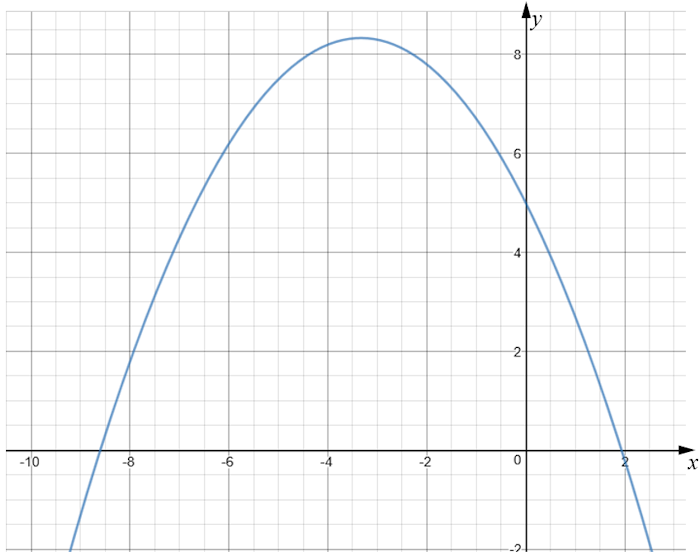
(b) Write down estimates for the roots of f(x) = 0
(c) Use the graph to find an estimate for f(-5.5).
9. | IGCSE Extended |
(a) Show that the equation \(\frac{3}{x+1}+\frac{3x-9}{2}=1\) can be simplified to \(3x^2-8x-5=0\).
(b) Solve the equation \(3x^2-8x-5=0\) showing all of your working and giving answers to three significant figures.
(c) The total surface area of a cone with radius \(x\) and slant height \(8x\) is equal to the area of a circle with radius r. Show that \(r = 3x\).
[The curved surface area, \(A\), of a cone with radius \(r\) and slant height \(l\) is \(A=\pi rl\).]
10. | GCSE Higher |
(a) By completing the square, solve \(x^2+8x+13=0\) giving your answer to three significant figures.
(b) From the completed square you found in part (a) find the minimum value of the curve \(y=x^2+8x+13\).
11. | GCSE Higher |
In this question all measurements are in centimetres.
The height of a triangle is \(h\) and the height of a rectangle is \((h + 4)\).
The length of the base of the triangle is \(x\) and the length of the rectangle is \((x + 2)\).
The area of the triangle is \(21 \text{ cm}^2\) and the area of the rectangle is \(90 \text{ cm}^2\).
(a) Write down an expression, in terms of \(x\), for the height of the rectangle.
(b) Show that \(x^2 - 10x + 21 = 0\).
(c) By factorising and solving \(x^2 - 10x + 21 = 0\), find the two possible heights of the triangle.
Image not drawn to scale, nor to the proportions of the triangle and rectangle mentioned in the question. In fact, this image is for decoration only and has nothing to do with the question
12. | IB Studies |
Consider the graph of the function \(f(x)=7-3x^2-x^3\)
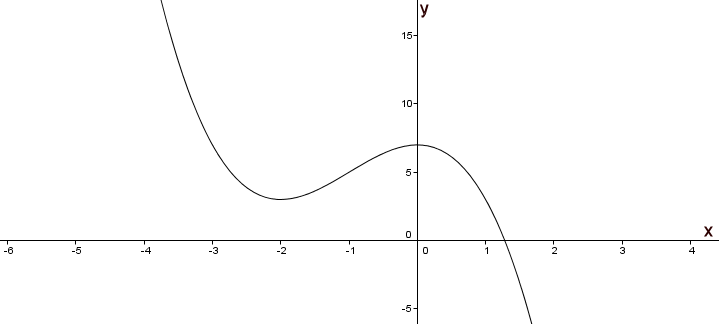
(a) Label the local maximum as A on the graph.
(b) Label the local minimum as B on the graph.
(c) Write down the interval where \(f(x)>5\).
(d) Draw the tangent to the curve at \(x=-3\) on the graph.
(e) Write down the equation of the tangent at \(x=-3\).
13. | IB Studies |
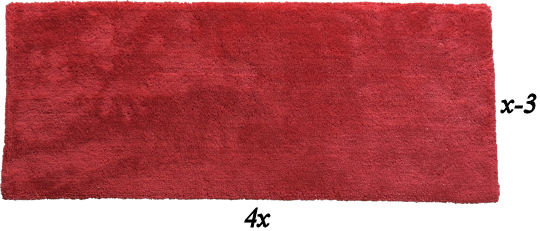
A red rug has a width of \(x-3\) cm and a length of \(4x\) cm.
(a) Write down an ex
The area of the rug is 3240 cm2.
(b) Calculate the value of \(x\).
(c) Hence, write down the value of the length and of the width of the rug in centimetres.
14. | GCSE Higher |
The graph of the following equation is drawn and then reflected in the x-axis
$$y = 2x^2 - 3x + 2$$(a) What is the equation of the reflected curve?
The original curve is reflected in the y-axis.
(b) What is the equation of this second reflected curve?
15. | GCSE Higher |
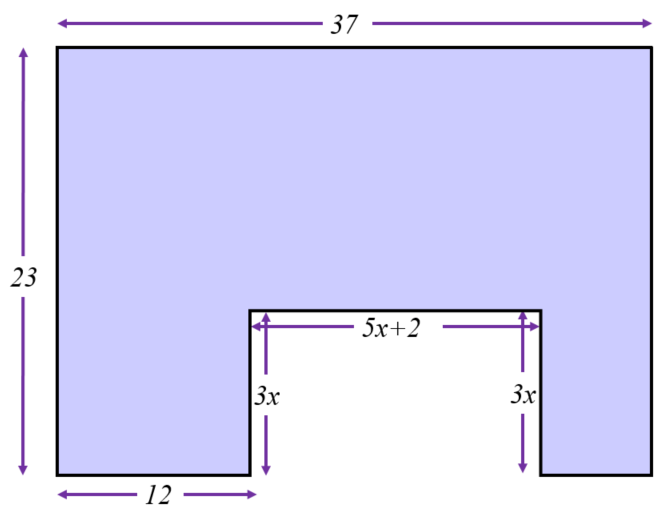
In the diagram below, which is not drawn to scale, all dimensions are in centimetres and all angles are multiples of 90o. If the shaded area is 698cm2, work out the value of \(x\).
16. | GCSE Higher |
Given that:
$$ x^2 : (5x + 3) = 1 : 3 $$find the possible values of \(x\).
17. | GCSE Higher |
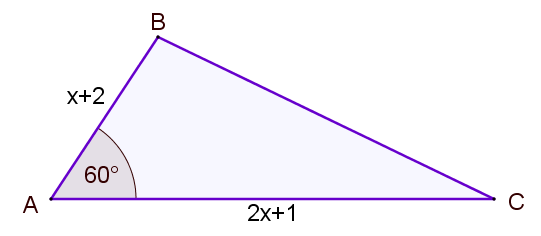
The area of triangle ABC (not drawn to scale) is
$$ \frac{35 \sqrt{3}}{4} m^2$$If AB = \(x+2\) metres and AC = \(2x+1 \) metres, find the value of \(x\).
18. | GCSE Higher |
(a) Write \(2x^2+8x+27\) in the form \(a(x+b)^2+c\) where \(a\), \(b\), and \(c\) are integers, by 'completing the square'
(b) Hence, or otherwise, find the line of symmetry of the graph of \(y = 2x^2+8x+27\)
(c) Hence, or otherwise, find the turning point of the graph of \(y = 2x^2+8x+27\)
19. | IB Analysis and Approaches |
The function \(f\) is defined by:
$$f(x) = \frac{4x+2}{x+1}, \quad \text{ where } x \in \mathbb{R}, x \neq -1 $$(a) Write down the equation of the vertical asymptote of the graph of \(f\).
(b) Write down the equation of the horizontal asymptote of the graph of \(f\).
(c) Find the coordinates of the \(x\)-axis and \(y\)-axis intercepts.
(d) Sketch the graph of \(f\).
20. | IB Analysis and Approaches |
A function \(f\) is defined by \(f(x) = 2 + \dfrac{1}{3-x}, \text{ where } x \in \mathbb{R}, x \neq 3.\)
The graph of \(y=f(x)\) has a vertical asymptote and a horizontal asymptote.
(a) Write down the equation of the horizontal asymptote;
(b) Write down the equation of the vertical asymptote;
Find the coordinates of the point where the graph of \(y\) intersects:
(c) the y-axis;
(d) the x-axis.
21. | IB Standard |
A function is defined as \(f(x) = 2{(x - 3)^2} - 5\) .
(a) Show that \(f(x) = 2{x^2} - 12x + 13\).
(b) Write down the equation of the axis of symmetry of this graph.
(c) Find the coordinates of the vertex of the graph of \(f(x)\).
(d) Write down the y-intercept.
(e) Make a sketch the graph of \(f(x)\).
Let \(g(x) = {x^2}\). The graph of \(f(x)\) may be obtained from the graph of \(g(x)\) by the two transformations:
(f) Find the values of \(j\), \(k\) and \(s\).
22. | IB Standard |
\(f\) and \(g\) are two functions such that \(g(x)=3f(x+2)+7\).
The graph of \(f\) is mapped to the graph of \(g\) under the following transformations:
A vertical stretch by a factor of \(a\) , followed by a translation \(\begin{pmatrix}b \\c \\ \end{pmatrix}\)
Find the values of
(a) \(a\);
(b) \(b\);
(c) \(c\).
(d) Consider two other functions \(h\) and \(j\). Let \(h(x)=-j(2x)\). The point A(8, 7) on the graph of \(j\) is mapped to the point B on the graph of \(h\). Find the coordinates of B.
23. | IB Standard |
The diagram shows part of the graph of \(f(x)=Ae^{kx}+2\).
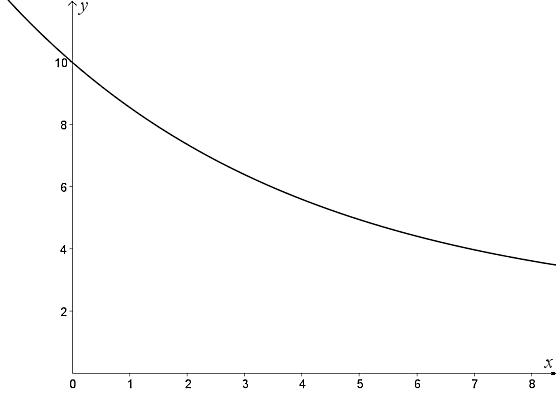
The y-intercept is at \((0,10)\).
(a) Show that \(A=8\).
(b) Given that \(f(8)=3.62\) (correct to 3 significant figures), find the value of \(k\).
(c) (i) Using your value of \(k\), find \(f'(x)\).
(ii) Hence, explain why \(f\) is a decreasing function.
(iii) Find the equation of the horizontal asymptote of the graph \(f\).
Let \(g(x)=-x^2+7x+5\)
(d) Find the area enclosed by the graphs of \(f\) and \(g\).
24. | IB Standard |
Let \(f(x) = \frac{9x-3}{bx+9}\) for \(x \neq -\frac9b, b \neq 0\).
(a) The line \(x = 3\) is a vertical asymptote to the graph of \(f\). Find the value of b.
(b) Write down the equation of the horizontal asymptote to the graph of \(f\).
(c) The line \(y = c\) , where \(c\in \mathbb R\) intersects the graph of \( \begin{vmatrix}f(x) \end{vmatrix} \) at exactly one point. Find the possible values of \(c\).
If you would like space on the right of the question to write out the solution try this Thinning Feature. It will collapse the text into the left half of your screen but large diagrams will remain unchanged.
The exam-style questions appearing on this site are based on those set in previous examinations (or sample assessment papers for future examinations) by the major examination boards. The wording, diagrams and figures used in these questions have been changed from the originals so that students can have fresh, relevant problem solving practice even if they have previously worked through the related exam paper.
The solutions to the questions on this website are only available to those who have a Transum Subscription.
Exam-Style Questions Main Page
To search the entire Transum website use the search box in the grey area below.